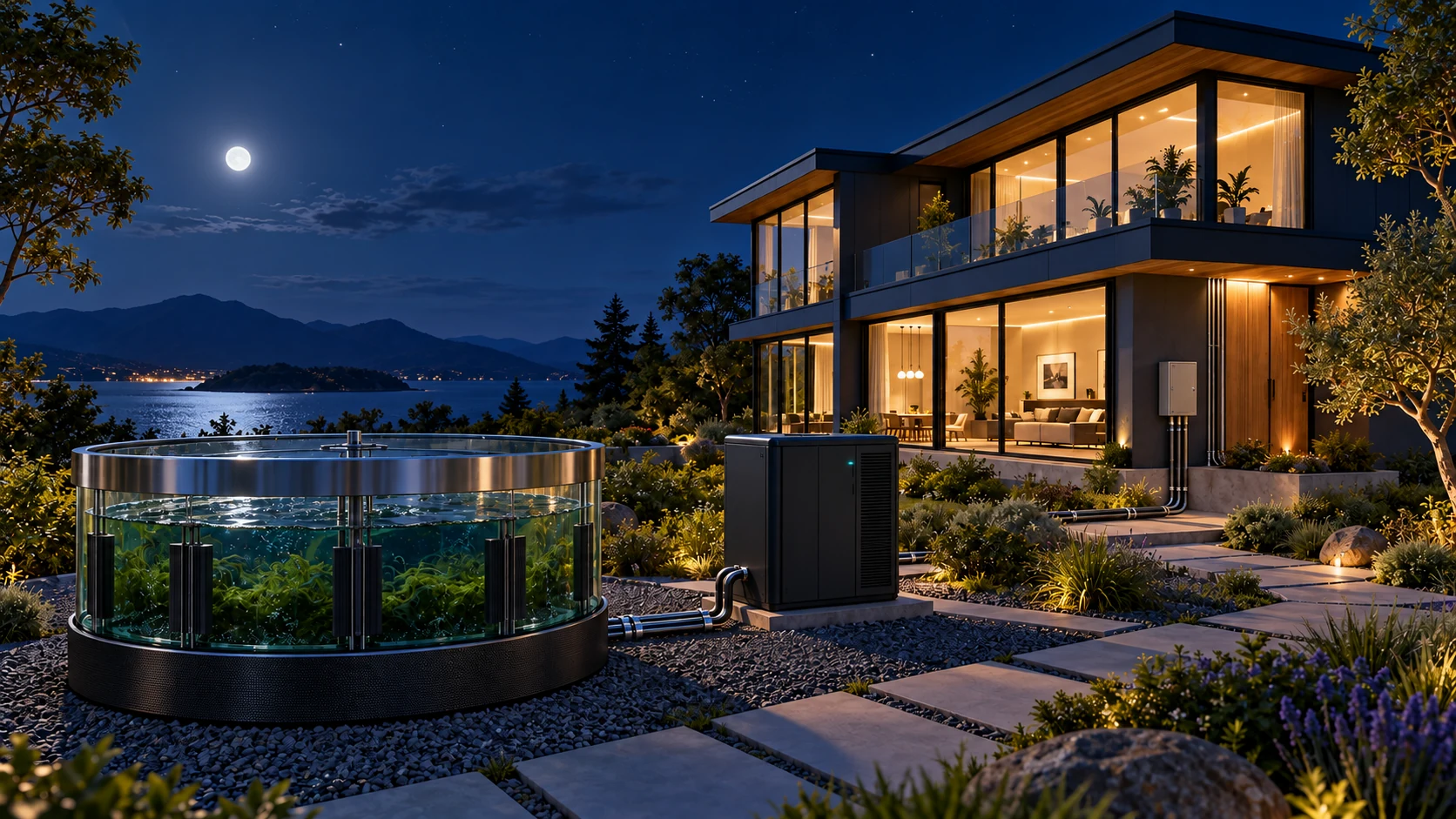
Absorb light
Pigments absorb selected wavelengths. Some light is reflected, transmitted or dissipated as heat. Illuminated area, spectrum and optical depth set the starting budget.
Our goal: capture sunlight in a living system, store the energy, and power a home beyond the grid.
FUTURE SYSTEM CONCEPT · Whole-home power is a long-term goal, not demonstrated Helios performance.
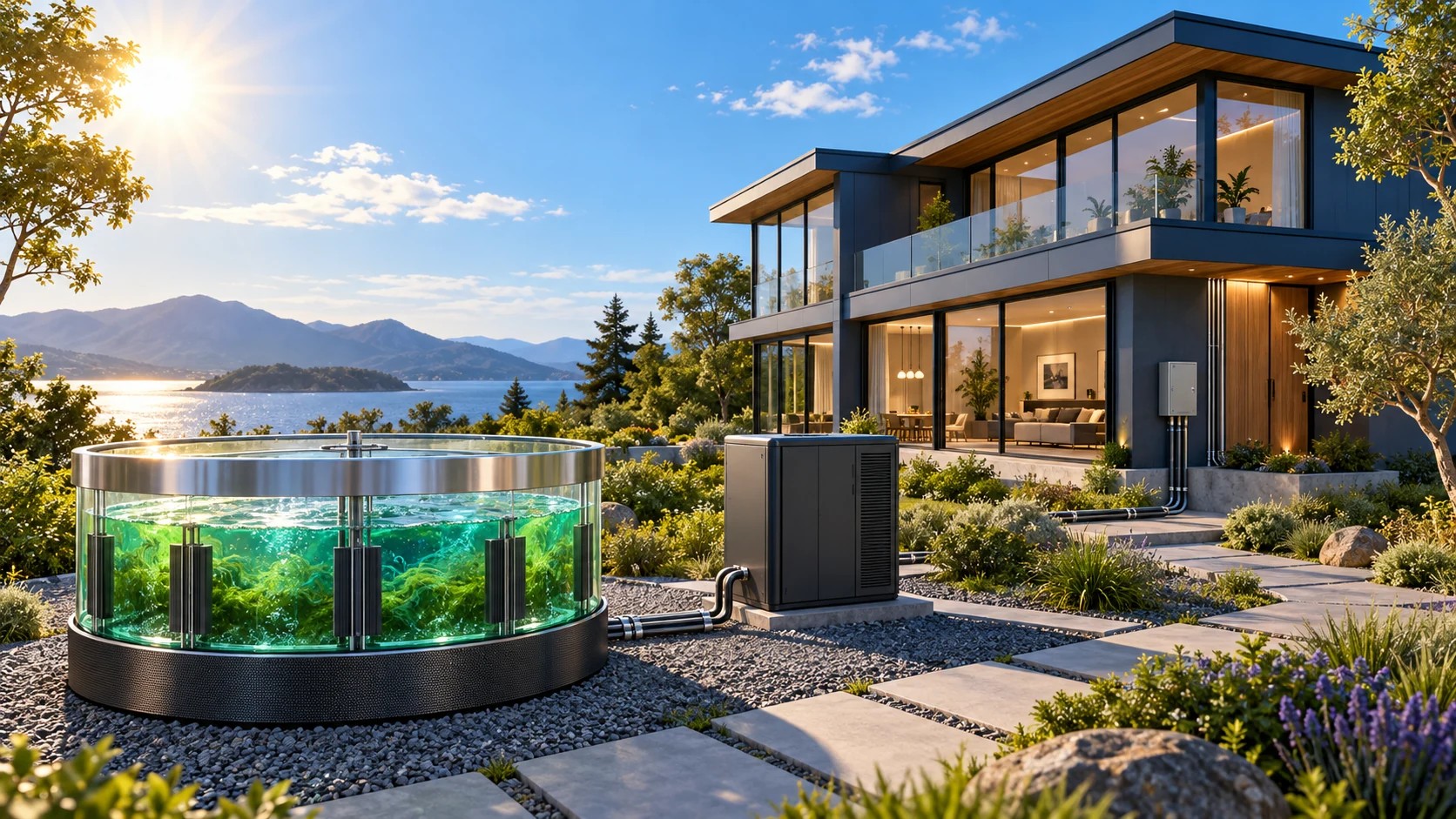
Sunlight reaches the living medium. The proposed collection system transfers electricity to storage, which would supply a regulated home circuit.
AI-generated day/night concept artwork with an illustrative energy-flow overlay. Household loads are potential end uses, not supported load ratings. The current research must first establish sustained net power. Paths simplify a protected electrical installation; this is not a wiring diagram.
Helios brings biology, materials, geometry and electrical engineering into one research program. The ambition is dependable local power: less dependence on fuel deliveries, more autonomy, and a lower environmental cost per useful kilowatt-hour.
The proposed full-scale form is a circular tank eight feet in diameter. A light-exposed living medium would feed electrical collection interfaces, power electronics and a storage system. The circular form is a design direction; its performance advantage must be tested against other geometries.
Sunlight is electromagnetic radiation. Helios aims to use a new harvesting architecture, rather than a new source of energy. Other electromagnetic inputs would require identifiable sources, appropriate transducers and separate energy measurements. [H5] [H9]
Select a component to explore how light, the living medium, collection interfaces and storage would work together. The cutaway is a functional illustration, not a physical simulation or live telemetry.
Day mode: incoming light supports living conversion. Collected electricity would be conditioned and stored for later use.
The proposed photosynthetic culture absorbs selected wavelengths and supports chemical electron-transfer reactions. Optical depth, culture stability and recoverable electrical energy must be measured together.
Pigments absorb selected wavelengths. Some light is reflected, transmitted or dissipated as heat. Illuminated area, spectrum and optical depth set the starting budget.
Photosynthetic reactions drive electron transfer and chemical energy storage. The challenge is directing a useful fraction toward collection while maintaining a stable living system.
An anode, cathode and ionic pathway complete the electrochemical circuit. Extracted power is voltage multiplied by current under load—not an open-circuit voltage alone.
A qualified external battery or capacitor provides a measurable first storage path. Biological reserves and possible redox storage are separate research directions, not rated battery capacity.
Regulated DC serves compatible loads; an inverter supplies AC where needed. Controls manage the load and reserve. Pumps, electronics and temperature control all consume energy.
Functional architecture proposed for Helios. It is not a construction drawing. Storage principles: [H6]; decoupled biological collection and delivery: [H2].
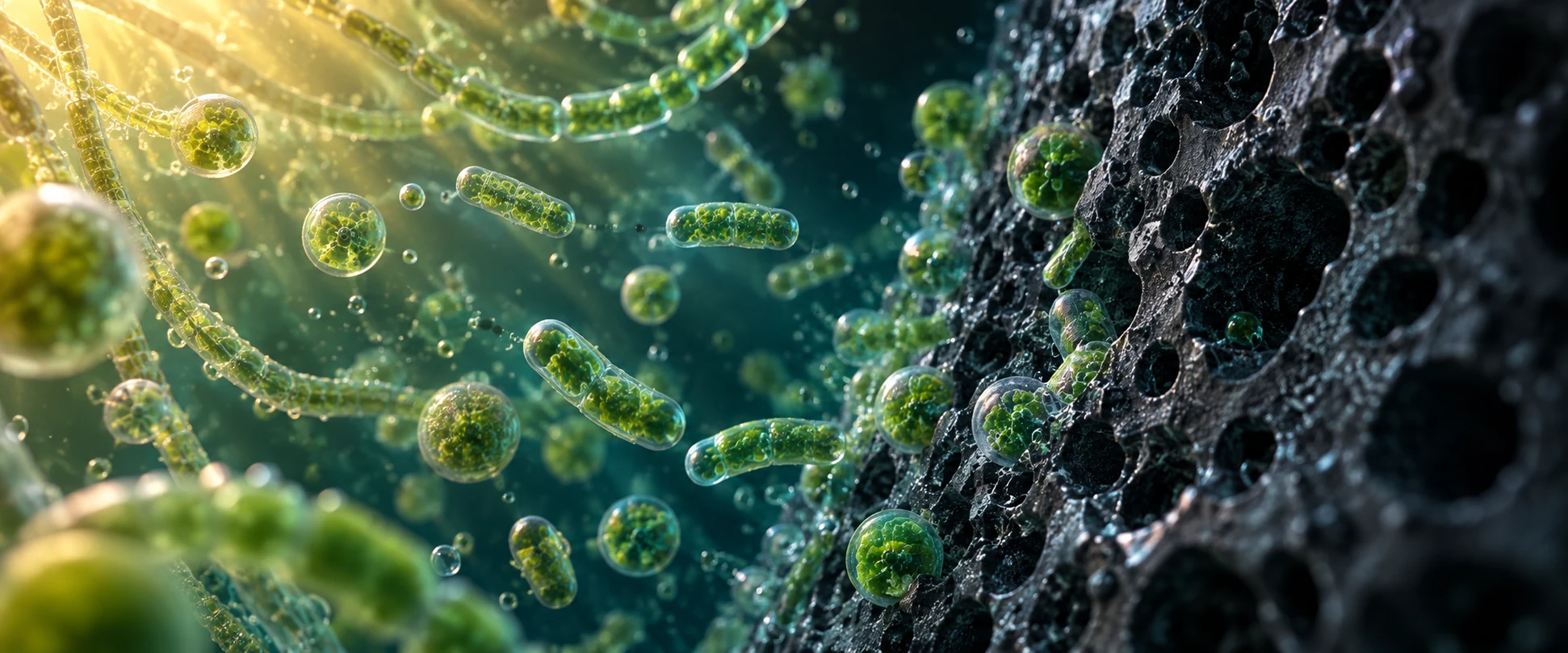
Cells must pass charge across a biological-material interface. Internal resistance, reaction kinetics, fouling and transport distances can reduce recoverable output. Dense cultures can also shade themselves: a deeper tank holds more material, but does not automatically intercept more sunlight.
Our proposed design studies therefore pair optical access with short collection paths, replaceable interfaces and low operating power. The development target is sustained net energy per illuminated area, followed by lifetime cost and reliability.
Within NetPhysics, Helios offers a physical testbed for relationships among geometry, energy transfer and retained state. A useful engineering result would be valuable on its own. Any claim of new physics would additionally require predictions that established electrochemistry and optics cannot explain.
Research priorities include transparent or porous collection structures, modular electrode zones, controlled culture depth and measured day/night response. None is treated as a confirmed Helios invention or selected production design.
Bombelli and colleagues operated a microprocessor with a small photosynthetic harvester for more than six months. This supports a practical starting point in very low-power electronics; it does not establish household-scale generation. [H1]
Chen and colleagues improved electron transfer using conductive polymer–cell composites. Their photocurrent work included applied-potential measurements. Such current enhancement cannot be read as unassisted system power. [H3]
Wang and colleagues reported about fourfold greater photocurrent using targeted conductive interfaces. This motivates interface research; the result does not multiply Helios output or establish its conversion efficiency. [H4]
Current, power and energy. Current in amperes describes charge flow. Power is V × I in watts. Delivered energy is the time integral of power in watt-hours. A potentiostat-assisted current measurement includes externally imposed conditions; a generator rating requires load delivery and a complete input balance.
Illuminated area versus electrode area. A study can normalize output to electrode area, reactor volume or illuminated footprint. These are different denominators. Published anode-area power densities cannot be multiplied by the tank’s top area to predict output. [H2]
Light energy versus chemical energy. Nutrients, organic feedstocks, electrode consumption and stored chemical reserves can contribute to electrical output. Day/night tests and material balances must identify those inputs before assigning all output to sunlight.
Broadband absorption versus usable conversion. Absorbing infrared can heat a culture without generating useful electricity. RF harvesting requires antennas and rectification. Field exposure alone is not an energy rating. Any additional collection area or supplied field must enter the input balance. [H9]
Change the assumptions. See the losses. This is a transparent scenario model—not measured Helios performance, a forecast, or a household power rating.
Unproven scenarios. The slider range is not an achievable Helios efficiency range.
Fixed assumptions: 4.67 m² top aperture; 90% conditioning; 92% inverter; all collected energy passes through storage. Support power is measured as a delivered-load-equivalent deduction. No side collection, concentration or other energy input included.
Enable JavaScript to explore the model.
A positive daily balance does not guarantee autonomy: hourly weather, startup demand, peak load, storage capacity, reserve and downtime still matter.
A = π × (2.4384 m / 2)² = 4.66982 m²
Esun = A × H
Enet = A × H × ηconversion × 0.90 × ηstorage × 0.92 − 24 × Psupport / 1000
ηrequired = [24 × (Pload + Psupport) / 1000] / [A × H × 0.90 × ηstorage × 0.92]
H is daily incident solar energy in kWh/m²/day; P is in watts; efficiencies are fractions; E is in kWh/day. Conversion includes optical and biological losses through collected DC. A negative net value is an energy deficit, not negative electricity production. The model does not resolve weather or hourly dispatch.
The 20% setting is an illustrative comparison point, not a Helios target achieved or a universal PV specification. Conventional PV plus storage remains a required real-world benchmark. [H5]
Power (kW) describes how quickly storage can deliver energy. Capacity (kWh) describes how much it can deliver over time. A large battery cannot compensate indefinitely for insufficient generation.
A 100 W load for 12 hours requires 1.2 kWh delivered. At 80% usable depth of discharge and 92% inverter efficiency, it needs at least 1.63 kWh nominal storage before reserve, aging and temperature margins. Helios has no established capacity rating. [H6]
Our goal is lower total loss than a defined competing system. The comparison starts with the same available resource and ends with the same useful service.
| Loss or constraint | Proposed engineering direction | Performance measure |
|---|---|---|
| Optical rejection and self-shading | Qualified optical depth, accessible surfaces and measured illumination geometry | Incident, reflected and transmitted light; output per aperture area |
| Biological diversion and unstable conversion | Stable culture conditions with a quantified conversion-to-collection pathway | Collected energy, culture health and repeatability over time |
| Interface and resistive loss | Short charge-transfer paths and serviceable collection materials | Loaded polarization curves, internal resistance and durability |
| Low-voltage conditioning | Converters matched to the actual source, including startup and quiescent draw | Energy in versus out over the real operating range |
| Storage and power delivery | Appropriate storage duration; direct DC where the load permits | Round-trip efficiency, self-discharge, inverter idle power and usable life |
| Operating overhead | Low-energy circulation, monitoring and thermal strategy | Net delivered kWh after every auxiliary input |
For an eight-foot tank, the optical aperture is a hard starting constraint. At an assumed irradiance of 1,000 W/m², about 4.67 kW reaches the top surface before any conversion. Concentration, side illumination or an expanded collector could alter the budget, but their additional collection area and losses must be counted.
The long-term opportunity is a distributed energy system that can displace higher-emission electricity, reduce fuel logistics and keep useful services operating where dependable power is scarce.
A qualified system could serve remote sensing, communications and other small loads that otherwise depend on fuel or frequent battery replacement. Larger applications require larger demonstrated output.
Replaceable biological and electrical modules could support repair. Any benefit depends on measured maintenance, culture stability, material consumption and the usable life of the complete system.
Global impact comes from reliable units delivering useful energy at scale. Unit count alone is insufficient: net output, actual utilization, displaced generation and manufacturing emissions determine the result.
Uses the net-energy scenario above, repeated for 365 identical days. That is an arithmetic assumption, not an annual yield prediction. The illustrative emissions factors below are editable and are not measured Helios values.
Enable JavaScript to explore this scenario.
Net delivered kWh/year × units × (displaced intensity − Helios life-cycle intensity). Positive = potential avoided emissions; negative = higher emissions. No benefit is reported when the energy scenario has a deficit.
Tank and electrode materials, nutrients, water treatment, imported power, maintenance, storage replacements and end-of-life treatment all belong in the carbon assessment. The intensity must be divided by actual lifetime useful output, with a consistent boundary for the displaced source. [H8]
Carbon taken up during growth can return through respiration, decay or processing. A carbon-removal claim requires a separate mass balance and durable carbon fate. Helios’s first climate objective is useful electricity with lower life-cycle emissions—not an assumed carbon credit.
Repeat under matched illumination, medium-only and nonliving controls. Track electrode consumption, stored chemical inputs and instrument effects. Establish the biological contribution before scaling.
Publish simultaneous voltage and current, time-integrated energy, uncertainty and independent runs. A resistor or specified device provides a clearer milestone than an isolated electrical reading.
Measure all operating power, charge/discharge energy and initial/final storage state. Demonstrate that the system produces more useful electrical energy than its support equipment consumes.
Qualify storage, source recovery, load peaks and weather variability. Track maintenance and stability over meaningful durations. Benchmark the same service against conventional solar plus storage.
Measure scale effects before assigning a capacity rating. The pilot needs containment, weather protection, electrical isolation, battery protection, safe maintenance access and a documented operating envelope.
The primary research and institutional sources behind this chapter. External results are distinguished from Helios goals and observations. Research reviewed October 19, 2026.
A small biological harvester operated a low-power microprocessor for more than six months. It is evidence for low-power applications, not household-scale output.
Separate charging and delivery stages enabled independent optimization. Reported power density uses anode area and cannot be multiplied by tank footprint to predict Helios output.
Conductive biological composites improved cell-to-electrode transfer. Photocurrent measurements included an applied electrode potential; they are not standalone net-power ratings.
Targeted conductive interfaces produced about fourfold greater photocurrent under the study conditions. Neither the multiplier nor the laboratory result establishes Helios efficiency or output.
Defines conversion of incident solar energy into electricity and the efficiency boundary.
Storage shifts availability in time and introduces its own capacity, power and conversion constraints.
U.S. transmission and distribution losses averaged about 5% over this historical period. This is not a measure of generation or storage efficiency.
Life-cycle comparisons include upstream, operating and downstream emissions per delivered energy unit.
RF harvesting requires a source-specific antenna, matching and rectification system. A spectral survey and measured input are essential.
Project-reported live-culture electrical response. Biological attribution, load power and net energy remain unresolved.
AI assisted research synthesis, writing, design and concept imagery. Equations and scenarios are explicit engineering calculations. Artwork and motion illustrate proposed operation; they are not measured data.
Explore the research, discuss a technical collaboration, or follow the next public milestone.